We all have stories we tell ourselves—about who we are, what we can do, and what’s possible. But not all of these stories serve us. Some hold us back, keep us small, and quietly shape the limits of our lives. These are called limiting beliefs, and they often go unchallenged for years.

Let’s explore what they are, how they’re formed, and what you can do to rewrite your story.
What are Limiting Beliefs?
Limiting beliefs are assumptions or convictions that restrict your thinking, behavior, and, therefore, life potential. In fact, they show up in everyday life as repeating thoughts. They are often perceived as inner truths and hard facts. Sometimes, having limiting beliefs could keep you from even trying to perceive new opportunities, change for the better, or work on your relationships.
Limiting beliefs act as huge fences in your mind — you don’t even think about what’s behind, as it is “impossible to reach” anyway.
In reality, limiting beliefs are perceptions formed based on past experiences, repeated conditioning from parents, in school or society. They also might be rooted in strong negative emotions such as fear, shame, and guilt.
Here are some examples of common limiting beliefs:
- “I’m not good enough.”
- “I’ll never make enough money.”
- “I don’t deserve love.”
- “It’s too late to change.”
- “I can’t trust anyone.”
The tricky thing is, to those who have them, these beliefs may sound extremely familiar and even protective. However, in real life, they create barriers to your growth and keep you stuck.
How are Limiting Beliefs Formed?
Limiting beliefs often form in childhood when our brains are very plastic and responsive, absorbing everything without much filter. It is especially beneficial for learning new skills, languages, and in general, it makes children quick learners and very adaptive. The flip side of this is that children are extremely impressionable and are prone to negative influences.
It goes extremely fast — one negative experience or critical comment, especially from someone you trust as a child, and it can create a lifelong “truth.”
The limiting beliefs can also be passed down through culture, education, religion, or family. Over time, repetition and emotional intensity cement them into our mental picture of ourselves.
For instance, if you were told as a child, “You’re not good at math,” and you struggled in one class, you might grow up believing you’re just not a “numbers person.” As a result, you might avoid anything to do with math and numbers, such as jobs and responsibilities, for the rest of your life, not because you actually lack the ability, but because you have this belief.
Beliefs can also be formed as a protective mechanism in your childhood or later in life. If you were hurt in a relationship, you might create a belief that “being close to people will eventually hurt.” This belief serves as a way to protect you from being in relationships and eventually being hurt. Of course, over time, these protective beliefs might isolate or prevent a genuine connection in your life.
What is the Limiting Belief Cycle?
All our beliefs are self-reinforced; in this way, our psyche is kept stable, and our habits do not change easily. This is true for both limiting and empowering beliefs we have. Of course, this makes it more difficult to change and to break free from the limiting beliefs.
The self-fulfilling cycle of limiting beliefs looks like this:
- Beliefs: “I’m not good enough.”
- Emotions: You feel anxious, insecure, or defeated.
- Thoughts: “I will not make it, I don’t have enough expertise.”
- Decisions: “I will not start this new thing.”
- Actions: You hold back, play small, or don’t try at all.
- Confirmations: Nothing changes, and your fear is reinforced. “See? I knew I couldn’t do it”.
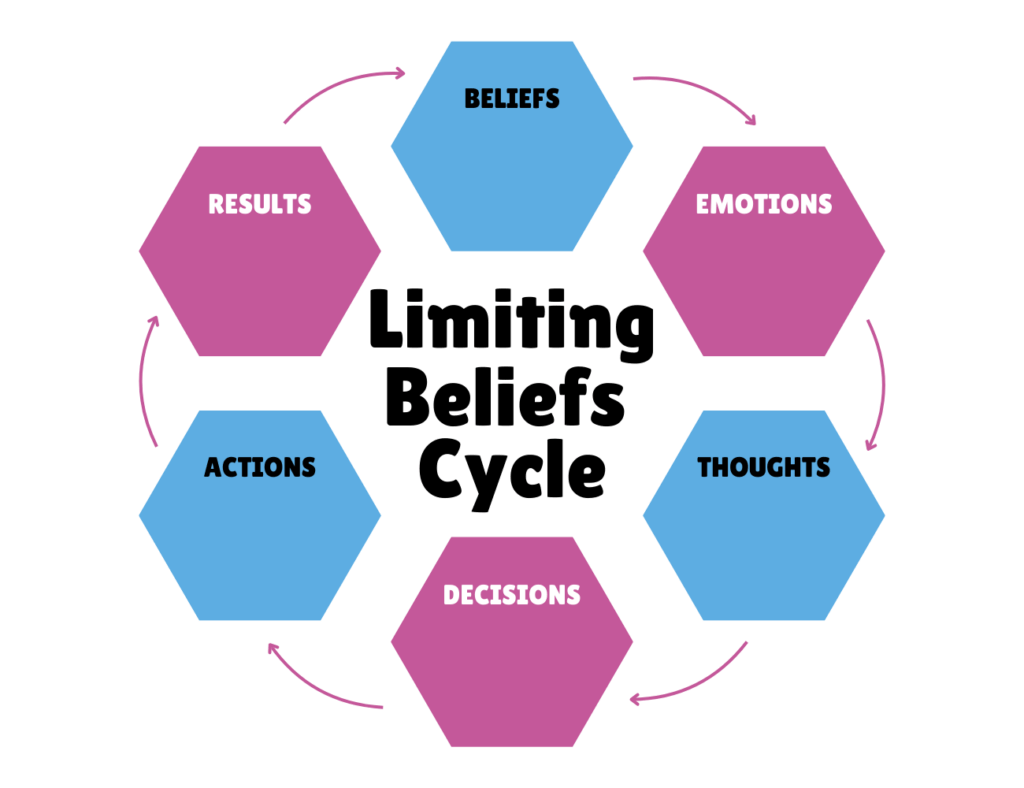
Each time we go through this cycle, we gather more “evidence” to support the belief. In turn, it makes it even more real. Then we stop questioning it, and it becomes part of our reality, integrating deep into our psyche. The more this cycle is repeated, the more deeply embedded the belief becomes. It becomes a lens through which we interpret life.
This cycle, even if it doesn’t serve us, becomes a comfort zone; that’s why it is very convenient to stay there and not change.
Challenge to Overcome Limiting Beliefs
Overcoming limiting beliefs means disrupting this cycle. It means:
- Becoming aware of the belief
- Questioning its truth
- Choosing a new belief and taking action that supports it
Yes, it takes consistent effort. Yes, it’s uncomfortable. But it’s possible. And it’s worth it!
The first step is always awareness. Noticing when that inner voice says, “I can’t,” or “I shouldn’t.” And here you begin to investigate: Who told me that in the past? Where did I learn this? Is it still true?
Change doesn’t happen all at once. It’s about small, consistent steps. Each time you challenge an old belief, you weaken its power. Each time you act on a new belief, you build strength in a new direction.
Why Most People Never Get Rid of Limiting Beliefs?
Limiting beliefs often feel like facts or part of their personality. They’ve been reinforced for years in the self-fulfilling cycle and mostly feel safe and convenient to believe.
It’s easier to stay in the comfort zone than to risk failure or rejection. Even pain can feel safer than uncertainty.
And let’s be honest: challenging a belief often means confronting uncomfortable truths. It may mean admitting we’ve held ourselves back or missed out on opportunities. That’s not easy to face. Therefore, most people hold to their limiting beliefs, and they are not changed unless absolutely necessary due to extreme difficulties in life.
But here’s the truth: the longer you cling to an old belief, the longer you postpone the life you could be living.
The fact is, you didn’t choose most of your beliefs consciously. But now you have the chance to reshape them.
29 Examples of Limiting Beliefs by Topic
Career
- “I’m not leadership material.”
- “I’m too old to switch careers.”
- “No one will take me seriously.”
- “I’m too young to take this role.”
- “My experience is not enough.”
- “I need to work hard to earn the respect of others.”
- “I own my success to someone else.”
Money
- “I’ll never be wealthy.”
- “Money is evil.”
- “I have to work hard to deserve abundance.”
- “I constantly lose money.”
- “Happiness depends on money.”
Love & Relationships
- “I’m not lovable.”
- “All the good ones are taken.”
- “Relationships never last.”
- “Relationships will always hurt.”
- “I need romantic relationships to be fulfilled.”
Health & Body
- “I’ll never be fit.”
- “I don’t have the discipline to eat healthy.”
- “I’m just built this way.”
- “I easily catch a cold.”
- “I’m prone to be overweight.”
- “I will never achieve a healthy lifestyle.”
Creativity & Self-Expression
- “No one wants to hear what I have to say.”
- “I’m not talented enough.”
- “It’s too late to start.”
- “I’m just a usual person, I’m nothing special.”
- “My ideas are not interesting to others.”
- “If I share my ideas, nobody will listen.”
Notice how these beliefs not only reflect fear or doubt, but they often contain finality. Moreover, words like “never,” “always,” or “too late” signal a fixed mindset.
6 Steps to Overcome Any Limiting Belief
These are the steps to work on your limiting beliefs and to transform them into the belief that will truly serve your life. These are the steps I used to change my own beliefs, too.
1. Identify the belief
What’s the thought holding you back? Write it down.
When do you think about it most often? What triggers it?
2. Ask where it came from.
Is it really yours, or was it inherited from someone else?
Who taught you this belief? Did they live the life you want?
3. Challenge its truth.
What evidence supports it? What contradicts it?
Can you think of one person who defies this belief?
Can you think about situations in your life when this wasn’t true?
4. Replace it.
Create a new belief that’s empowering and believable.
Example: Change “I’m not creative” to “I’m learning to express my creativity.”
5. Take action to prove it.
Small wins build new proof and slowly rewire your mindset.
Every time you act from the new belief, you strengthen it.
6. Repeat consistently.
Change doesn’t happen overnight. Consistency creates change.
What is Neuroplasticity?
Neuroplasticity is your brain’s ability to change and adapt throughout life. It means that the neural pathways in your brain aren’t fixed—they can be rewired by new experiences, new thoughts, and new behaviors. The neuroplasticity of our brains remains throughout our lives. So it is never too late!
This is what makes personal growth possible. When you choose a new belief and act on it consistently, your brain starts building new connections. Over time, the old belief pathway weakens, and the new one strengthens.
Think of it like hiking. The first time you walk a new path, it’s rough and hard to follow. But the more you walk it, the clearer and easier it becomes. The same happens in your brain.
That’s why mindset work is so important. You’re not just “thinking positive”—you’re literally changing your brain.
Final Thoughts
Remember, personal development is a journey, and that’s a powerful place to be.
Limiting beliefs are not part of your personality. They are self-reinforced through thoughts and actions in a continuous cycle. Becoming aware of your beliefs is the first step to transforming them.
In order to break the limiting beliefs cycle, you can consistently act differently, think differently, and as a result feel differently about yourself.